

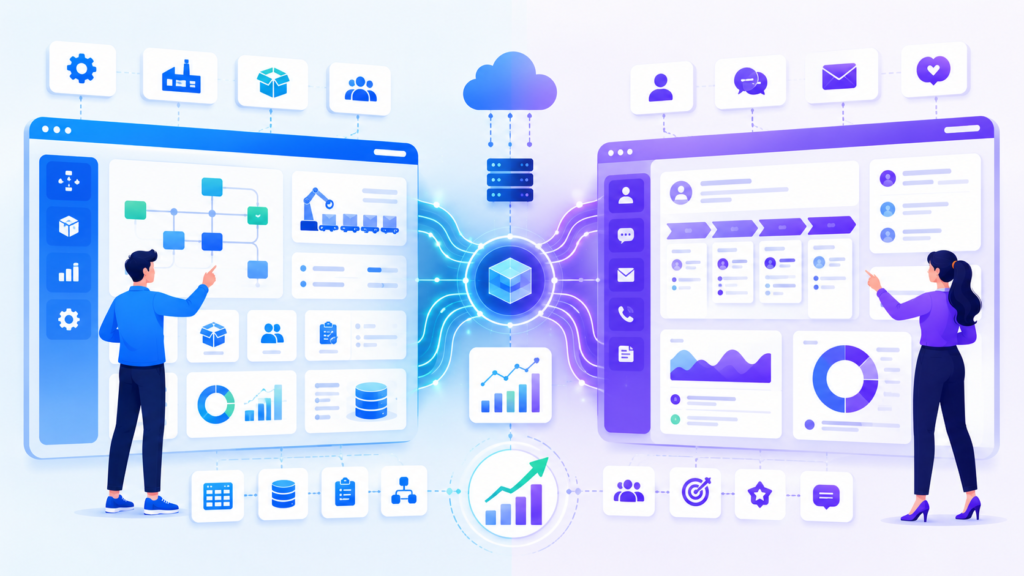
Modern businesses rely heavily on software systems to manage operations, customer relationships, and decision-making. Among the most important business technologies are ERP (Enterprise Resource Planning) and CRM (Customer Relationship Management) platforms. Although both improve efficiency, they solve different business challenges.
ERP systems focus on internal operations such as finance, inventory, procurement, and resource planning, while CRM platforms are designed to improve customer interactions, sales performance, and relationship management. Understanding the difference helps businesses make smarter technology investments.
This article explains how ERP and CRM systems work and how organizations can choose the right solution.
Understanding ERP Systems
ERP platforms connect multiple business functions into one centralized environment, allowing teams to work with consistent and real-time information.
Businesses using ERP often improve operational visibility and process control.
ERP capabilities include:
- Inventory management
- Finance and accounting
- Procurement workflows
- Resource planning
- Business reporting
- Understanding CRM Systems
CRM platforms focus on improving customer relationships and supporting sales growth.
Businesses can manage interactions more efficiently while delivering better customer experiences.
CRM capabilities include:
- Customer data management
- Sales pipeline tracking
- Lead management
- Customer communication
- Performance analytics
- When Businesses Should Integrate Both
Many growing organizations combine ERP and CRM to create a connected digital ecosystem. Integration helps improve collaboration across departments while increasing operational efficiency.
A unified system supports better decision-making and long-term business scalability.
Combined business advantages:
- Centralized information
- Improved productivity
- Faster decision making
- Better customer experiences
- Higher operational efficiency
Conclusion
Choosing between ERP and CRM depends on business priorities, operational complexity, and growth objectives. In many cases, integrating both systems creates the strongest foundation for scalable business operations.
Colorbox Technologies develops intelligent software solutions that help businesses operate more efficiently and grow with confidence.

